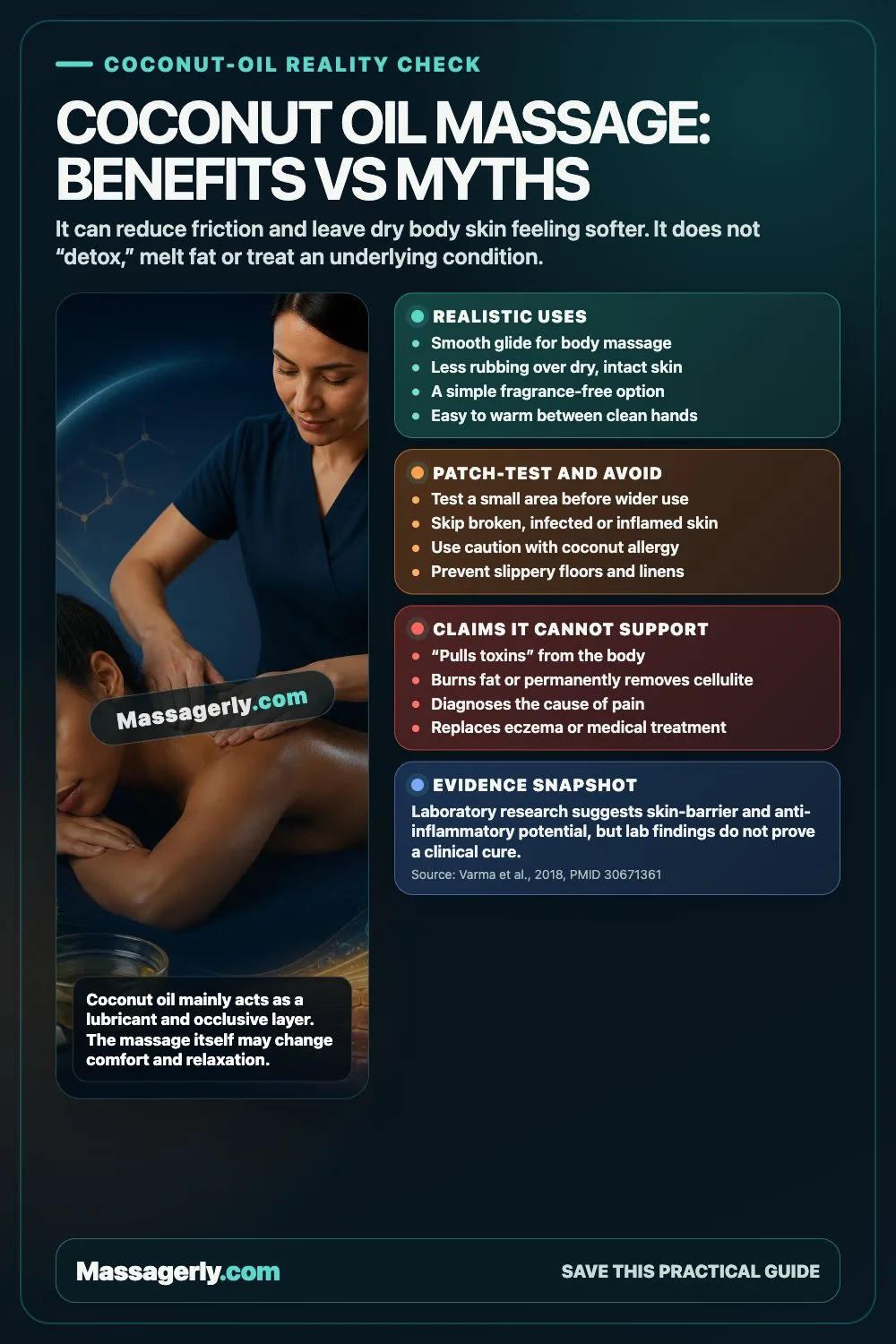
This article reviews what coconut oil itself contributes to massage. Our separate body-massage guide explains application, patch testing and cleanup in detail so the two pages do not compete for the same question.
Benefit 1: durable massage glide
Coconut oil remains slippery longer than many light lotions. That can reduce friction during slow strokes on intact body skin. Glide is a mechanical benefit; it does not mean nutrients travel through the skin into muscles or organs.
Benefit 2: surface moisturization
Topical coconut oil can reduce water loss and soften some dry skin. Research on moisturization does not prove improved circulation, faster muscle healing, cellulite removal or treatment of eczema in every person.
Benefit 3: a predictable texture
Virgin coconut oil has a distinctive scent and becomes solid in a cool room, while fractionated coconut oil stays liquid and usually feels lighter. The choice is about texture, ingredients and skin tolerance—not a hierarchy of medical benefits.
Where coconut oil may be a poor fit
- Acne-prone facial, chest or back skin
- Known coconut or fragrance sensitivity
- Broken, infected or freshly treated skin
- Latex condoms or barriers, because oils can weaken latex
- Situations where staining or difficult cleanup matters
Claims the evidence does not support
| Claim | Evidence-aware conclusion |
|---|---|
| Detoxification | No established massage-toxin pathway |
| Weight or fat loss | Topical massage does not create meaningful fat loss |
| Immune boosting | Skin application has not been shown to strengthen whole-body immunity |
| Hormone balance | No reliable evidence for a systemic hormonal effect |
| Infection treatment | Do not apply massage oil as a substitute for diagnosis or treatment |
What current evidence says
Clinical research supports coconut oil as a topical moisturizer in selected populations, but those findings must remain limited to skin outcomes. The CDC advises against oil-based lubricants with latex condoms because oil can weaken latex.
Related Massagerly guides
Read how to use coconut oil for body massage, facial pore and acne considerations, hair-use evidence, safe mixing options and the patch-test guide.
What the oil contributes—and what the hands contribute
Coconut oil reduces friction and slows water loss from the surface of some dry, intact skin. The massage itself supplies pressure and movement. Neither component should be credited with treating infection, changing hormones, producing weight loss or strengthening immunity. Keeping those effects separate makes the recommendation more accurate.
Virgin, refined and fractionated coconut oil
| Type | Typical feel | Useful limitation |
|---|---|---|
| Virgin | Coconut scent; solid or soft in a cool room | Scent and heaviness may not suit everyone |
| Refined | Usually less coconut aroma | Processing differs by manufacturer; read the label |
| Fractionated | Liquid and lighter-feeling | Not compositionally identical to virgin coconut oil |
“Natural,” “organic” and “cold pressed” do not guarantee that a product will be non-irritating or appropriate for the face, genitals, broken skin or latex barriers. The ingredient list and the user’s history matter more than marketing language.
A practical first-use method
- Check the ingredient list for fragrance and other additives.
- Patch test a small amount on intact skin.
- Use only enough oil to reduce drag; more oil does not create more benefit.
- Keep it away from eyes, mucous membranes and open skin.
- Stop for burning, hives, increasing redness or swelling.
- Wash oily linens according to the manufacturer’s care instructions and store oil cool, dry and closed.
Important sexual-health limitation
Oil-based products can weaken latex condoms. The CDC’s safer-sex guidance recommends water- or silicone-based lubricant with latex condoms. Check the barrier manufacturer’s directions rather than assuming every oil and barrier are compatible.
Questions readers often ask
Is coconut oil anti-inflammatory on the whole body?
Laboratory properties or a topical skin study do not establish a whole-body anti-inflammatory treatment. Describe the observable outcome—glide or moisturization—without upgrading it into disease therapy.
Can it be used on acne-prone skin?
Some people find it too occlusive, especially on the face or back. A non-comedogenic, fragrance-free product may be a better starting point.
Does warming make it more effective?
Warming changes feel and melting state, not proven therapeutic power. Test the temperature on your inner wrist and avoid microwaving a container that can form hot spots.
How to decide whether coconut oil is the right massage oil
Start with the body area, skin condition and practical setting. A heavier oil may work well for a slow body massage but feel uncomfortable on an acne-prone face. A product with coconut fragrance may be pleasant for one person and trigger headache or irritation for another. If a partner or therapist is applying the oil, both people should know the ingredients and agree to stop if the skin reacts.
For eczema, recurrent dermatitis, severe allergy history or a current skin condition, product choice may need individualized advice. A successful patch test reduces uncertainty but cannot guarantee that a larger area or repeated exposure will remain reaction-free. Use clean hands, avoid returning contaminated oil to the container and discard a product that smells stale or has changed unexpectedly.
Saveable visual summary