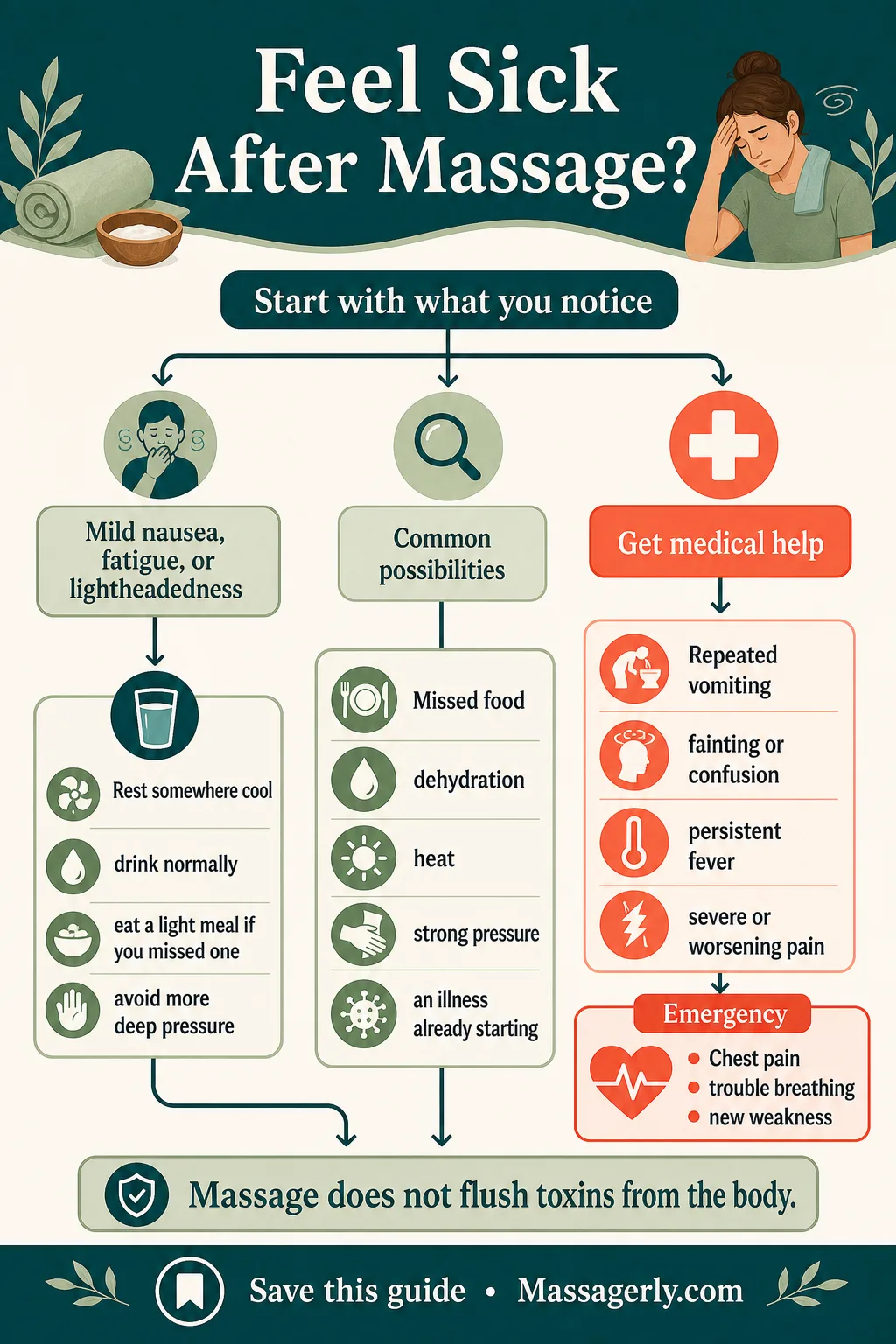
This page focuses on symptoms that begin during a session or within the first few hours. That is different from widespread flu-like symptoms and different again from the expected tenderness that may follow strenuous or deep-tissue work.
Immediate nausea or light-headedness
Stop the session, sit or lie somewhere safe and avoid driving until steady. Review whether the room was hot, the face cradle or neck position was uncomfortable, you stood up quickly, you skipped food, or a familiar migraine trigger was present. Drink according to thirst; there is no need to force water to flush toxins.
Fatigue after an intense session
A long session can feel tiring, particularly when someone was already sleep-deprived, unwell or anxious. Fatigue alone does not prove that the immune system was activated. Rest and monitor the pattern. New fever, cough, sore throat, diarrhea or worsening body aches should be treated as possible illness rather than a beneficial reaction.
Soreness versus injury
Diffuse, mild tenderness that gradually improves is different from sharp pain, neurological symptoms, marked swelling or dark urine. Pain during massage is not evidence that a knot is being released. Stronger pressure is not automatically more effective.
Can massage spread infection?
Close contact can expose people to respiratory or skin infections, and massage over infected skin can worsen irritation. Postpone massage when you have fever, vomiting, diarrhea, a contagious respiratory illness or an unexplained rash. Clean hands, linens and equipment remain basic precautions.
When symptoms need urgent attention
Seek urgent help for breathing difficulty, chest pain, fainting, confusion, new weakness or numbness, severe headache, repeated vomiting, rapidly increasing swelling or dark urine. Contact a clinician when a measured fever persists or symptoms are worsening rather than settling.
How to reduce the chance of another reaction
- Tell the therapist about migraine, vertigo, allergies, reduced sensation, pregnancy and relevant medicines.
- Begin with lighter pressure and a shorter session.
- Ask for neutral neck positioning and fragrance-free products.
- Stop when symptoms begin instead of trying to work through them.
- Record timing and triggers if the pattern repeats.
What current evidence says
NCCIH’s massage overview describes generally low risk when massage is used appropriately but acknowledges rare serious adverse events. Evidence about sport massage does not support claims that symptoms represent toxin clearance.
Related Massagerly guides
Use the more specific guides for fever and widespread flu-like symptoms, the 48-hour sports/deep-tissue recovery window, dizziness and vertigo, headache and pressure stop signals.
Use timing to narrow the possibilities
| Timing | What to consider | Practical response |
|---|---|---|
| During the session | Pressure, heat, scent, face-cradle position, anxiety or pain | Stop, sit up slowly and tell the therapist |
| Within a few hours | Missed food, caffeine change, migraine, motion sensitivity or ordinary soreness | Rest, eat and drink normally, then reassess |
| Next day with fever or respiratory symptoms | An infection or other illness may be developing | Avoid close-contact appointments and follow medical guidance |
| Progressive or severe | Not a routine response | Seek prompt assessment |
What massage research can and cannot tell us
Studies of massage differ in technique, pressure, session length and population. Evidence about short-term pain or relaxation outcomes does not prove that massage causes fever, purges toxins or creates a predictable “healing crisis.” The U.S. National Center for Complementary and Integrative Health describes massage as generally low risk when performed appropriately, while noting rare serious injuries and the need for extra caution with vigorous techniques or higher-risk people.
How to reduce avoidable discomfort next time
- Share migraine, vertigo, reflux, pregnancy, anticoagulant use, recent surgery and active injuries before the session.
- Request a lower temperature or fragrance-free product if heat or scent is a trigger.
- Use a lighter pressure trial instead of assuming deeper is better.
- Do not schedule massage when feverish or acutely unwell.
- Ask for position changes before nausea, numbness or dizziness becomes intense.
Do not normalize these symptoms
Repeated vomiting, fainting, confusion, chest pain, breathing difficulty, one-sided weakness, a new severe headache, rapidly expanding swelling, severe pain or dark urine are not signs that treatment is “working.” Stop the session and obtain appropriate care.
Questions readers often ask
Can deep pressure make nausea more likely?
Some people find pain, abdominal pressure, heat or prolonged face-down positioning nauseating. That is a reason to change or stop the session, not proof of detoxification.
Should I drink several extra liters of water?
No special flushing dose is established. Drink normally unless a clinician has given you a different fluid plan.
Can I book again the next day?
Wait until unexplained symptoms have settled and their likely cause is clear. Do not use another massage to treat fever, severe symptoms or a possible injury.
Saveable visual summary