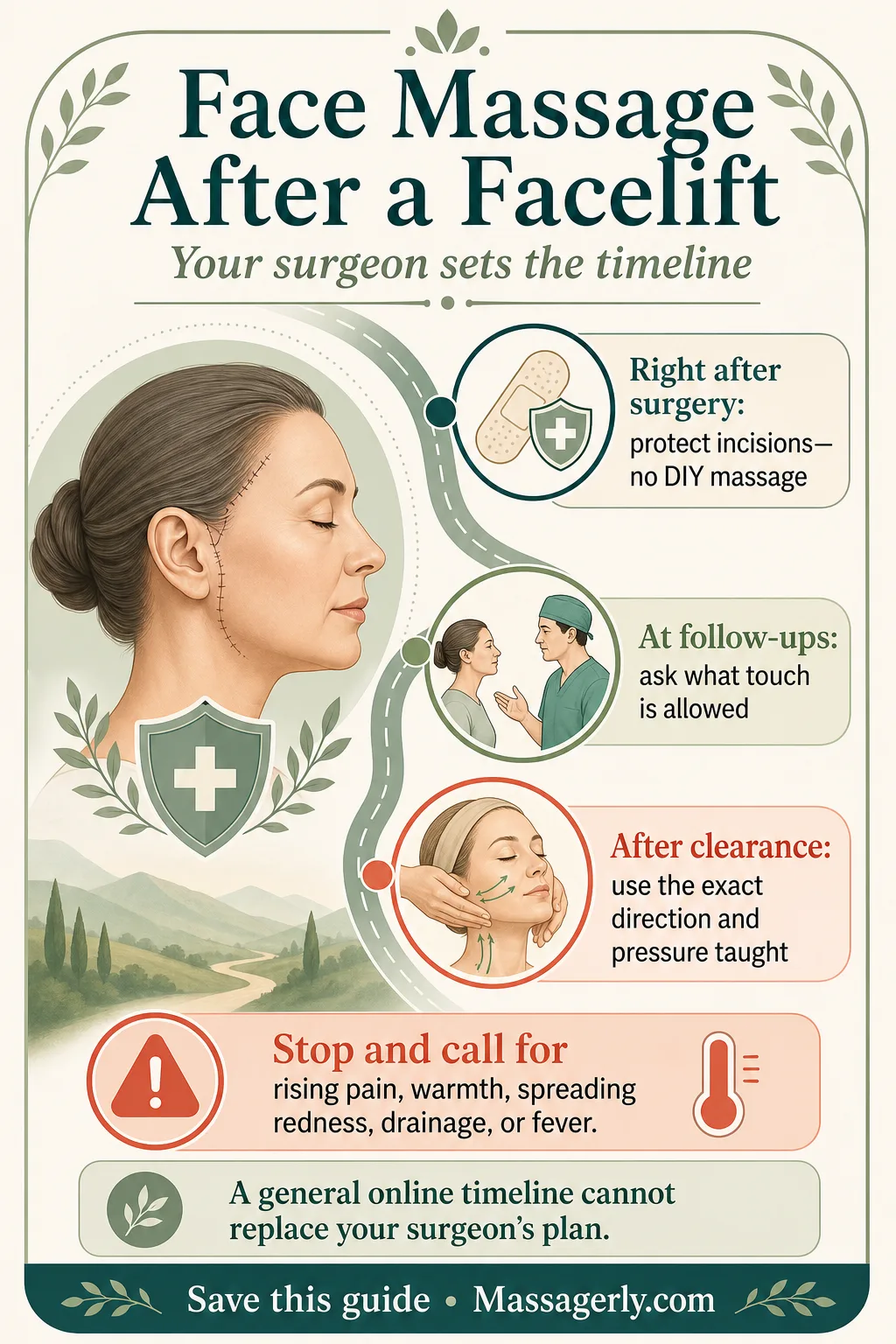
Postoperative massage is different from ordinary facial massage. The surgeon knows which tissue planes were lifted, whether drains or grafts were used, and where tension must be protected. Internet timelines cannot replace those instructions.
Why timing cannot be universal
Early healing includes swelling, bruising and vulnerable incisions. One surgeon may recommend a specific light lymphatic technique while another may prohibit massage for longer. Do not use a calendar alone; obtain written clearance and ask which exact areas and pressure are allowed.
Questions to ask the surgeon
- When may I touch the operated areas beyond routine cleansing?
- Is massage recommended for my procedure or not?
- Which direction, duration and pressure should be used?
- Should a trained postoperative therapist perform it?
- Which products are safe near incisions?
- What changes mean I should stop and contact the office?
Techniques not to improvise
Avoid deep kneading, pinching, scraping tools, suction cups, vigorous rollers, percussion devices and sustained acupressure. Do not attempt to push swelling toward a node or flatten a firm area without instruction. Scar massage also starts only when the incision is appropriately closed and the surgeon approves it.
Products and hygiene
Use only products allowed by the surgical team. Botanical oils, essential oils and ‘natural’ balms can irritate healing skin or complicate wound assessment. Wash hands, keep tools away from incisions and do not share applicators.
Urgent postoperative warning signs
Contact the surgical team promptly for rapidly increasing one-sided swelling, expanding bruising, wound opening, pus, fever, worsening redness, severe pain or facial weakness. Sudden breathing difficulty, chest pain, confusion, major bleeding or new vision loss needs emergency care.
Recovery priorities
Follow instructions about head elevation, activity, medicines, compression, wound care and follow-up appointments. Massage is optional and procedure-specific; it is not the measure of whether healing is progressing.
What current evidence says
The American Society of Plastic Surgeons emphasizes individualized instructions for surgical-site care, medicines, concerns and follow-up. That supports surgeon-led timing rather than a universal home-massage schedule.
Related Massagerly guides
Read non-surgical facial massage limits, massage after under-eye filler, nose massage after rhinoplasty, eye-area pressure safety and skin-product precautions.
A surgeon-led decision table
| Situation | Do not assume | Ask instead |
|---|---|---|
| Early swelling | That it must be pushed out | Is this expected for my operation? |
| Firm or numb area | That hard massage will soften it safely | Should the area be examined first? |
| Scar care | That every incision starts massage on the same day | Is the incision closed enough, and what pressure is allowed? |
| Therapist appointment | That “post-op massage” training fits every procedure | Does my surgeon recommend this therapist and protocol? |
Why generic online timelines are risky
“Facelift” can refer to different operations and combinations of procedures. Tissue planes, incision sites, drains, fat grafting, eyelid surgery and complications alter aftercare. The American Society of Plastic Surgeons emphasizes procedure-specific surgical-site care, medicines, concerns and follow-up. That is why this article does not prescribe a universal day for massage.
Prepare for the follow-up visit
- Write down when swelling, pain or firmness changed.
- Photograph a concerning change in consistent light if the office requests it.
- Bring the exact oils, rollers or scar products you want to use.
- Ask the surgeon to demonstrate allowed direction and pressure.
- Request written restrictions so a therapist does not improvise.
Questions readers often ask
Does everyone need lymphatic massage?
No. It may be recommended for selected patients, but it is not a universal requirement or a substitute for postoperative review.
Can massage prevent all scar tissue?
No. Scar behavior depends on healing, procedure and individual factors. Begin scar care only when the surgical team approves it.
What if swelling suddenly increases?
Do not try to massage it away. Contact the surgical team promptly, especially when swelling is one-sided, painful, rapidly expanding or accompanied by bleeding, fever or wound changes.
What a responsible postoperative therapist should know
A therapist should ask what procedure was performed, when it occurred, whether complications developed and what the surgeon has authorized. “Lymphatic,” “scar” or “post-op” on a service menu does not by itself establish that the technique fits a particular facelift. Permission should cover the face and neck areas involved, not merely say that general massage is allowed.
During any approved session, pressure should remain within the written plan and communication should be continuous. New pain, bleeding, warmth, spreading redness, drainage, dizziness or rapid swelling should end the session. The appropriate next step is contact with the surgical team, not a stronger attempt to move fluid.
Saveable visual summary