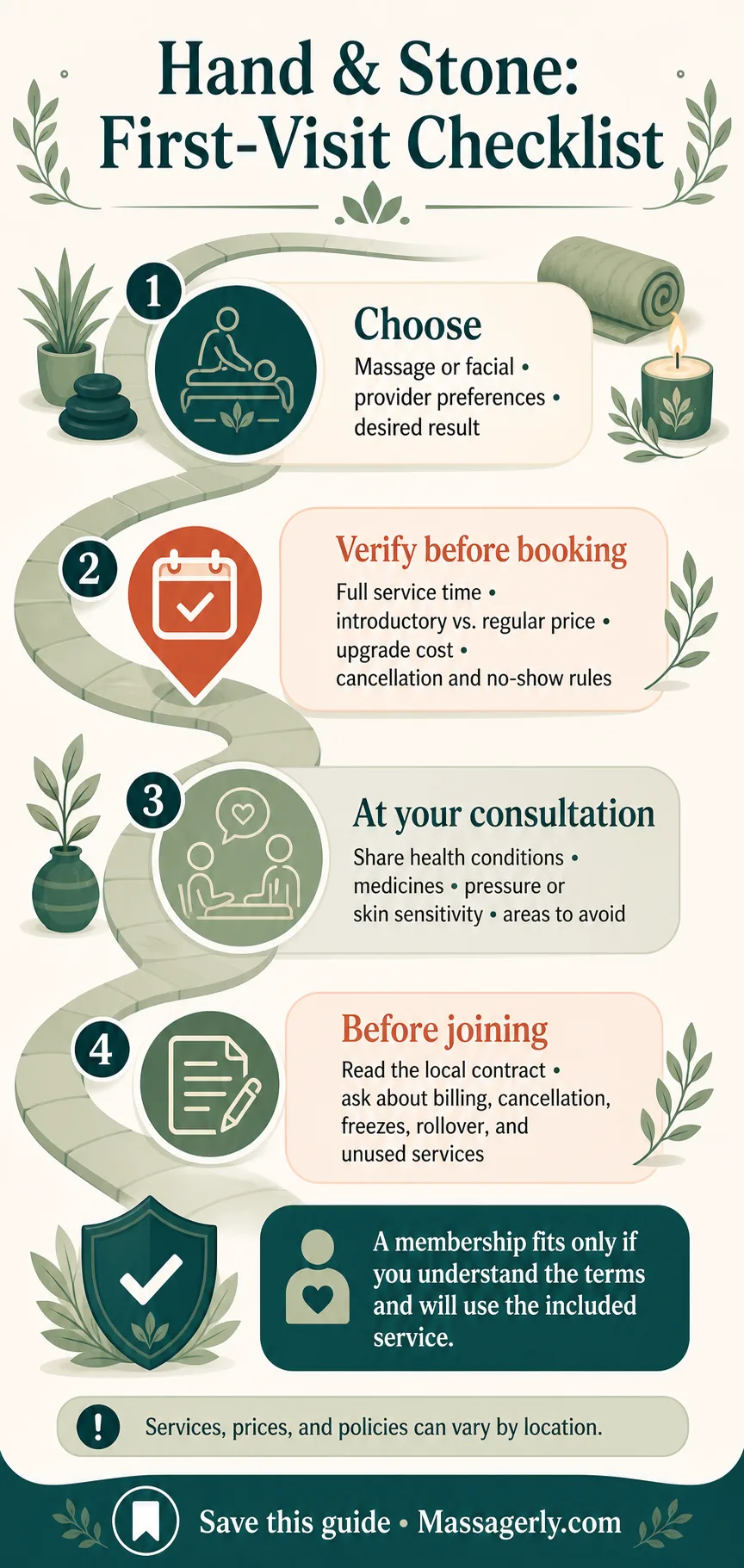
Hand & Stone can be a convenient option when you want a massage or facial without planning a full resort-spa visit. It also has enough location-to-location variation that a national menu alone cannot tell you exactly what your appointment will cost or include.
This independent guide explains how to compare services, what usually happens during a first visit, how the membership works, which questions to ask before paying and how to avoid treating promotional language as a health guarantee. Massagerly is not affiliated with Hand & Stone.
Hand & Stone at a glance
| Question | Practical answer |
|---|---|
| What is it? | A franchise network of day spas offering massage, facials and location-dependent add-on services. |
| Do you need a membership? | No. One-time appointments are generally available, while membership provides a recurring monthly service and other benefits under written terms. |
| Are prices the same everywhere? | No. Local pages show different member and nonmember prices, and promotions can change. |
| Is a “one-hour” service 60 minutes hands-on? | Not necessarily. Official pages state that service time can include consultation and dressing. |
| Are all services at every spa? | No. Massage types, facial brands, advanced treatments and practitioner availability vary. |
| Where should you verify details? | The exact spa’s official location and booking page, followed by a direct call when something is unclear. |
What services does Hand & Stone offer?
The official Hand & Stone website currently organizes its menu around massage and facials, with some locations also listing toning, injectables, hair removal or other body and skin services. Availability depends on the spa, state rules, equipment and the practitioners scheduled there.
Use the national menu to understand categories, then use the local booking page to confirm the actual service, duration, price and provider. A treatment described nationally may not appear at the nearest franchise.
Massage services
Common local menus include classic or Swedish-style massage, deep-tissue options, hot-stone or Himalayan salt-stone massage, prenatal massage, oncology massage and selected specialty techniques. These labels describe the planned style; they do not guarantee a medical result or identical pressure at every location.
- Classic or relaxation massage: usually the simplest first-visit option when the goal is comfortable general massage rather than very firm pressure.
- Deep tissue: may use slower or more focused pressure. “Deep” should still be negotiated, and sharp, burning, electric or numbing sensations are reasons to stop.
- Hot stone or salt stone: adds heated tools. Ask how temperature is checked and speak up immediately if a stone feels too hot.
- Prenatal massage: requires pregnancy-aware positioning and an appropriately trained practitioner. Confirm the location’s trimester and health-history policies before arrival.
- Oncology massage: should be adapted to treatment history, symptoms, medical devices, skin condition and clinical advice. Confirm the individual practitioner’s relevant training rather than relying only on the menu label.
- Specialty techniques: lymphatic drainage, reflexology, trigger-point work and other options may appear locally. Ask what the service involves and what credentials are required in that state.
Massage may support comfort and relaxation, but a spa menu should not be read as a promise to cure chronic pain, prevent injury, remove toxins or speed healing. If you are choosing between heat-based treatments, our hot-stone versus hot-oil comparison explains the practical differences and temperature risks.
Facial services
Official Hand & Stone pages currently list classic, hydrating, brightening, anti-aging, soothing and clarifying facials, plus location-dependent enhancements. The company also lists professional product lines including Dermalogica, IMAGE Skincare and ClarityRx. Names and brands can change, so confirm the current menu before booking.
A facial should begin with questions about skin goals and relevant history. Tell the esthetician about allergies, active rash, cold sores, eczema or rosacea flares, recent sunburn, prescription retinoids, isotretinoin, recent peels, laser treatment, injectables or surgery. A promotional treatment description is not a diagnosis, and a spa facial does not replace dermatology care for persistent or concerning skin problems. If a fragranced oil or massage add-on is offered, our sensitive-skin massage-oil guide explains ingredient and patch-testing questions.
Advanced skincare, hair removal and other services
Some locations advertise peels, DiamondGlow, LED, microcurrent, waxing, body treatments, toning or injectables. These services differ more than a basic massage or facial because equipment, practitioner licensing and state rules matter. Check who performs the procedure, what it is intended to do, common side effects, contraindications, required aftercare and the total price before accepting an upgrade.
How much does Hand & Stone cost?
There is no accurate nationwide price table. Official location pages show different rates, and the amount can change with city, appointment length, membership status, service type, provider, enhancement and promotion. A price quoted for one Texas or Florida spa should not be presented as the price at every U.S. location.
For an honest comparison, record the following from the exact location:
- Nonmember price for the base service you actually want.
- Introductory price and who qualifies for it.
- Member price and the monthly membership charge.
- Extra cost for longer appointments, stones, enhanced pressure, products or technology.
- Whether the displayed appointment time includes consultation and dressing.
- Taxes, gratuity expectations and any cancellation or no-show fee.
Do not join only because the introductory visit appears inexpensive. Compare the full recurring cost with the number of appointments you will realistically use.
How the Hand & Stone membership works
The official membership page currently describes one massage or signature facial per month, member rates for additional services, reward points and nationwide use. The company also says it offers different membership tiers. Those headline benefits are only the beginning of the decision.
The published membership terms explain rules for recurring payments, service credits and what happens after cancellation. Local agreements and applicable state law can affect the exact process. Read the agreement provided by your spa, save a copy and do not rely on a verbal summary.
Membership questions to ask before signing
- What amount will be charged each month, on what date and by which business name?
- Is this month-to-month, prepaid or subject to a minimum term?
- Which exact service is included, and is consultation or dressing part of the listed time?
- What happens to unused credits while the membership remains active?
- Can credits be used at another franchise, transferred to a guest or applied to an upgrade?
- How much will an upgrade, longer appointment or additional monthly visit cost?
- How do freezes work, and are fees charged during a freeze?
- What form of cancellation notice is required?
- When do unused credits expire after cancellation?
- What happens if the local spa closes or you move?
The official terms currently describe post-cancellation deadlines for using accumulated services. Because those details can change and may interact with local agreements, verify the version you are accepting at the time of signup.
When membership may make sense
A membership can be practical if you already want a qualifying service every month, like the local practitioners and can reliably book at convenient times. It is less attractive when you travel frequently, prefer different independent providers, expect to skip months or would struggle to manage cancellation and unused-credit deadlines.
A simple break-even calculation is more useful than “membership always pays for itself.” Multiply the monthly charge by 12, add the upgrades you expect to buy, then compare that total with the nonmember visits you would actually book. Ignore theoretical savings on services you would not otherwise purchase.
What to expect at your first Hand & Stone visit
Individual experiences differ, but official service pages describe an intake questionnaire and consultation before treatment. Arriving early gives you time to read forms without cutting into an appointment that may already include consultation and dressing.
Before the appointment
- Confirm the address, parking, start time, service, provider and total expected price.
- Ask how much hands-on treatment time is included.
- Review the cancellation and late-arrival policy.
- Have relevant allergy, skin-care, medicine and health information available.
- Eat and drink according to ordinary comfort rather than following a detox routine. Our pre-massage food guide explains flexible timing.
During a massage consultation
Discuss the pressure you prefer, areas you want addressed, areas you do not want touched and any position that is uncomfortable. Ask how draping works. Consent is ongoing: you can request less pressure, a different technique, more coverage or an early stop at any time.
Mention recent injury, surgery, pregnancy, skin infection, unexplained swelling, easy bruising, numbness or medical advice that limits massage. The intake form helps communication; it does not turn a spa appointment into medical diagnosis or treatment.
During a facial consultation
Describe what your skin is doing now, not only the result you want. Provide current products and recent procedures. Ask what will be applied, whether exfoliation or extraction is included and what temporary redness, peeling or sensitivity may follow. You can decline an enhancement that was not part of the original plan.
After the service
Take a moment before standing, especially after a warm room or deeply relaxing session. Follow treatment-specific skin aftercare from the practitioner, and seek appropriate care for severe or worsening symptoms rather than assuming they are normal “detox.” Our deep-tissue massage aftercare guide covers practical recovery steps. If a sauna is available elsewhere in your day, review our sauna and massage safety comparison before adding more heat.
How to choose a location and practitioner
The nearest location is not automatically the best fit. Use the official location finder, open the individual spa page and compare:
- current local services and prices;
- appointment availability at the times you need;
- practitioner biographies or special training, when available;
- recent reviews that describe specific service and scheduling experiences;
- accessibility, parking, gender preferences and communication needs; and
- how clearly the spa answers membership and cancellation questions.
Reviews are most useful when they identify the location, date and type of appointment. A glowing or angry review of a different franchise does not reliably predict your local experience. For a search checklist, use our Hand & Stone near-me guide.
Gift cards: verify where and how they can be used
Hand & Stone sells gift cards, but the official gift-card terms distinguish cards purchased through the corporate webstore from cards issued by an independently operated spa. The terms also note that services and prices can vary by location.
Before buying, confirm the issuer, participating locations, expiration or inactivity rules allowed by law, whether the card covers gratuity, and what happens when the local service costs more than the card balance. Avoid unofficial resellers and look-alike pages.
Common mistakes to avoid
- Assuming national claims apply locally: verify the exact spa’s menu, price and hours.
- Comparing appointment labels instead of hands-on time: ask what a “one-hour” or “80-minute” service includes.
- Joining during a sales conversation without reading: take time to review cancellation and credit-expiry terms.
- Booking by the strongest health promise: choose based on comfort, practitioner fit and realistic goals.
- Withholding relevant information: disclose allergies, recent procedures and symptoms that could change the service.
- Assuming pain proves effectiveness: pressure should be adjustable, and sharp or neurological sensations are stop signals.
Frequently asked questions
Do I need to be a member?
No. Nonmember appointments are generally available. Membership is a recurring-purchase option, not an entry requirement.
How much is a massage at Hand & Stone?
There is no single national price. Check the official booking page for the exact location, service, duration and membership status. Confirm whether consultation and dressing are included in the advertised time.
Can I use my membership at another location?
The national membership page promotes nationwide use, but you should verify current rules, upgrade charges and credit handling with both locations before traveling.
Can unused services roll over?
The membership program describes monthly service credits, but rollover and post-cancellation use are governed by the current written terms. Ask the spa to show you the rule that applies to your agreement.
Are therapists and estheticians licensed?
Licensing requirements vary by state and profession. Ask the location who will perform your service and how to verify that person’s current license or credential with the relevant state board.
Is gratuity included?
Do not assume it is. Ask whether gratuity is included, which price is used for suggested percentages and what payment methods are accepted.
Can I cancel a membership at any time?
The national site describes member-friendly options, but cancellation method, notice, final charges and credit deadlines are controlled by the agreement and applicable law. Read and retain the written terms before signing.
Bottom line
Hand & Stone offers a broad, convenient spa menu, but the local franchise and individual practitioner determine much of the real experience. Use national pages to understand the program, then verify the local price, service, appointment time, provider and written membership terms.
The strongest decision is not “membership versus no membership” in the abstract. It is whether the exact location offers a service and practitioner you want at a total cost and schedule you will actually use. Read first, ask specific questions and keep health expectations realistic.
Massagerly is an independent educational website and is not affiliated with, endorsed by or sponsored by Hand & Stone. Services, prices, promotions and policies can change.