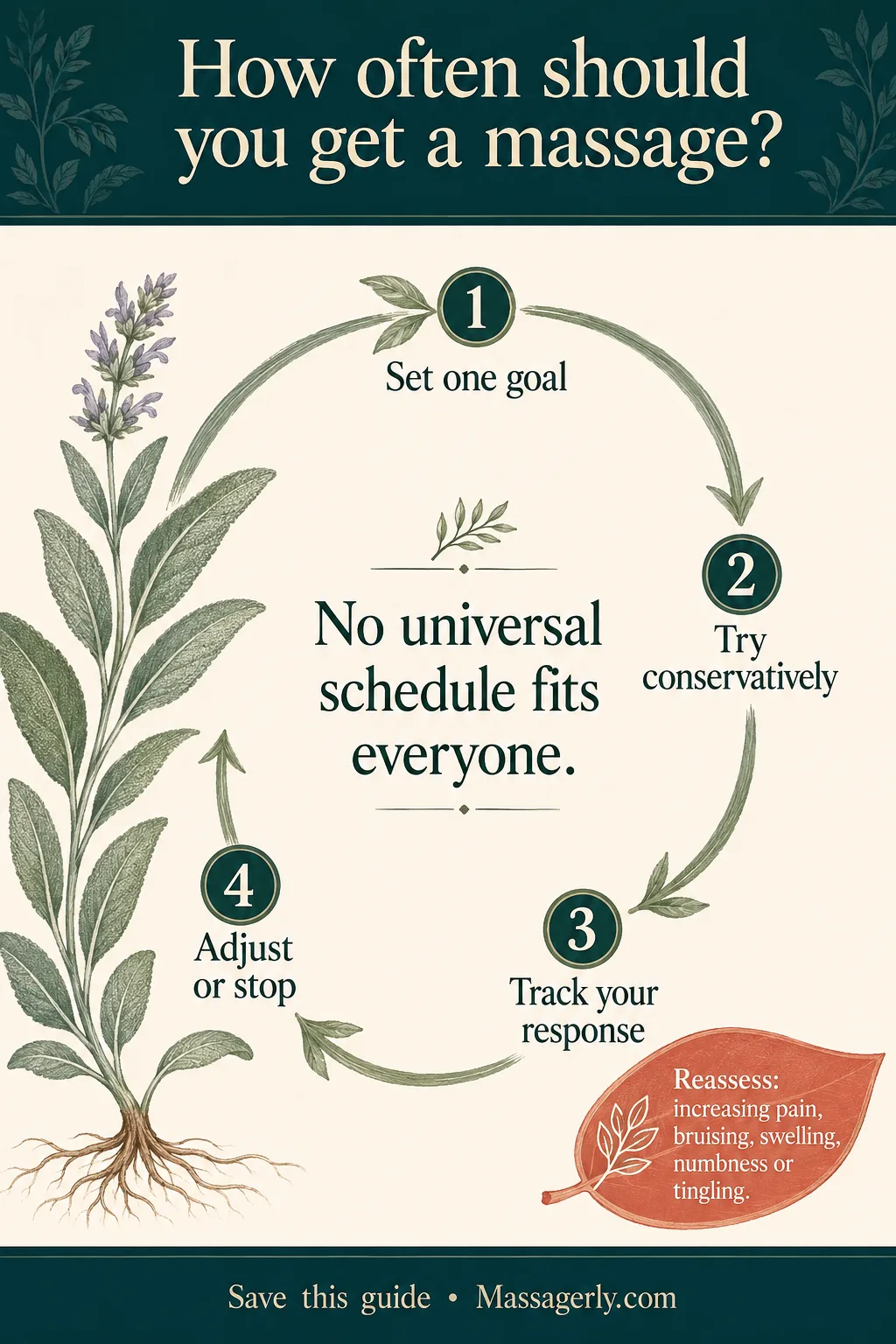
Direct Answer: There is no single biological schedule that applies to everyone. For general stress reduction and relaxation, booking once every 4 to 6 weeks is a sustainable interval that supports nervous system recovery without unnecessary expense. For specific complaints—such as chronic postural tension or athletic training—a temporary, targeted protocol of 1 to 2 sessions per week for 2 to 3 weeks is typically used in clinical studies, followed by an immediate transition to an extended maintenance schedule (every 3 to 6 weeks) as tissue adapts.
Key Rule: Frequency should always be dictated by your tissue response and clear functional goals, never by an arbitrary recurring calendar subscription. If post-session soreness persists past 48 hours or symptoms fail to improve after 3 consecutive sessions, more frequency is contraindicated.
Every commercial spa and membership clinic loves to recommend a standing monthly appointment. But from the perspective of human musculoskeletal biology and tissue remodeling, the human body does not operate on a 30-day billing cycle.
How often you should receive massage therapy depends strictly on three biological and mechanical variables: the mechanical depth of the modality (light lymphatic glide versus high-force deep tissue), the metabolic recovery capacity of your soft tissue, and the specific physiological outcome you are pursuing. A competitive marathoner flushing exercise metabolites requires an entirely different frequency than an office worker managing chronic trapezius stiffness or someone simply seeking parasympathetic nervous system decompression.
Below is an evidence-grounded framework detailing optimal massage frequency across different personal goals, backed by clinical trial protocols, tissue recovery timelines, and safety boundaries.
Evidence-Based Frequency Matrix by Goal
In randomized controlled trials evaluating manual therapy, protocols are designed with defined beginning, reassessment, and tapering phases. The table below summarizes these evidence-based intervals across common user goals:
| Primary Goal | Initial Phase Frequency | Maintenance Interval | Underlying Mechanism | Reassessment Trigger |
|---|---|---|---|---|
| Stress & Mental Fatigue | Every 2 to 4 weeks | Every 4 to 6 weeks (or as needed) | Parasympathetic upregulation, transient cortisol suppression | Diminishing perceived relaxation or cost friction |
| Chronic Desk Tension (Neck & Shoulders) | 1 session per week (for 2–3 weeks) | Every 3 to 4 weeks + daily ergonomic habits | Myofascial trigger point deactivation & mechanoreceptor reset | No mobility gain after 3 sessions; requires ergonomic or PT review |
| Athletic Training / Heavy Lifting | Every 7 to 14 days (timed with rest cycles) | Every 2 to 4 weeks during deloads | Reduction of muscle tightness, improved perception of recovery | Persistent soreness interfering with training load or technique |
| Non-Specific Lower Back Stiffness | 1 to 2 sessions per week (for 4–6 weeks) | Transition to active exercise & movement | Spinal paraspinal tone reduction & gate-control pain modulation | Radiating pain, numbness, or lack of progress (see doctor) |
| Post-Surgical / Lipo Recovery | 2 to 3 sessions per week (manual lymphatic drainage) | Tapers to zero as lymphatic collateral pathways clear | Extracellular fluid mobilization without mechanical tissue shear | Must follow surgeon's exact protocol; pause if fever or infection occurs |
1. Frequency by Specific Health & Fitness Goal
A. General Stress Relief and Autonomic Reset: Every 3 to 6 Weeks
If your primary motivation is decompressing from high-stress work or life demands, frequent mechanical intervention is unnecessary. Controlled trials using biometric markers (such as heart rate variability and salivary cortisol) demonstrate that Swedish or relaxation massage induces an immediate shift from sympathetic ("fight-or-flight") to parasympathetic ("rest-and-digest") dominance.
However, this autonomic shift is an acute physiological reset. While subjective calm lasts several days, scheduling sessions every 3 to 6 weeks provides a sustainable emotional buffer without creating psychological or financial dependency. For everyday stress between sessions, breathwork, progressive muscle relaxation, and adequate sleep provide comparable autonomic stabilization at zero financial cost.
B. Chronic Desk Posture and Neck/Shoulder Knots: The 3-Week Front-Loaded Reset
Prolonged sitting in front of monitors leads to sustained isometric contraction of the upper trapezius, levator scapulae, and rhomboids. This sustained ischemic contraction often produces sensitive, taut muscle bands commonly called myofascial trigger points.
To break this persistent tension cycle, standard clinical practice uses a short front-loaded trial:
- Weeks 1–3: 1 focused session per week (30 to 45 minutes targeting the shoulder girdle and thoracic spine).
- Weeks 4 and beyond: If significant relief and restored cervical range of motion occur, immediately extend the interval to once every 3 to 4 weeks.
The Golden Caveat: Massage therapy only changes muscle resting tone; it does not change the workstation ergonomics or postural habits that created the ischemia in the first place. If you do not adjust monitor height, desk setup, and micro-break routines, booking a weekly massage simply pays to temporarily soothe a problem you recreate every Monday morning.
C. Athletic Training and Muscle Recovery: Every 1 to 2 Weeks
For runners, cyclists, and strength athletes, massage frequency must align with training volume and periodization cycles. Research compiled by the Journal of Athletic Training indicates that post-exercise manual therapy improves perceived recovery and reduces the subjective severity of Delayed Onset Muscle Soreness (DOMS).
However, intense deep tissue friction is itself a form of controlled mechanical stress that induces cellular microtrauma. Booking an aggressive deep tissue session within 48 to 72 hours before a major race or heavy lifting meet can impair muscle spindle reflexes and force production. Learn optimal pre- and post-workout timing in our complete guide to exercise after massage.
D. Persistent Lower Back Pain: Time-Limited Clinical Blocks
The American College of Physicians (ACP) clinical practice guidelines recommend non-pharmacological therapies—including massage therapy, acupuncture, and spinal manipulation—as initial first-line options for acute, subacute, and chronic non-specific lower back pain.
When evaluated in randomized controlled trials, massage protocols for back pain typically involve 1 to 2 sessions per week for 6 to 10 weeks. Notice that these trials are explicitly time-limited. Massage therapy is intended to downregulate protective muscle guarding, creating an open window of mobility so you can engage in active rehabilitation exercises, core stabilization, and walking programs.
2. Modality Matters: How Technique Dictates Recovery Time
Asking "how often should I get a massage" without specifying the modality is like asking "how often should I exercise" without specifying whether you are walking or performing heavy deadlifts. Different techniques exert radically different physical stresses on your vascular and muscular systems:
Swedish / Relaxation
Tissue Impact: Superficial glide (effleurage) and kneading (petrissage). Minimal mechanical shear.
Recovery Required: None to 24 hours.
Safe Frequency: Up to 1–2 times weekly if desired, though every 3–4 weeks is optimal for most budgets.
Deep Tissue & Trigger Point
Tissue Impact: High focal pressure across fascia and deep muscle fibers. Induces intentional micro-inflammation.
Recovery Required: 48 to 72 hours minimum.
Safe Frequency: Maximum once per week during an active problem; once every 3 to 6 weeks for routine care.
Manual Lymphatic Drainage (MLD)
Tissue Impact: Extremely light, feather-touch skin stretching designed to stimulate lymph capillary uptake.
Recovery Required: Zero muscular recovery.
Safe Frequency: Often performed 2–3 times weekly immediately following cosmetic surgery or for clinical lymphedema under medical guidance.
Percussion Massage Guns
Tissue Impact: Rapid, motorized focal strikes (20 to 50 Hz). High potential for cumulative mechanical fatigue.
Recovery Required: 24 to 48 hours for identical muscle groups.
Safe Frequency: Daily use is acceptable only if limited to 1–2 minutes per muscle group at low-to-moderate stall force.
3. Why "Once a Month" is a Commercial Construct, Not a Biological Rule
The standard recommendation to "get a massage once a month" is largely an operational convenience created by spa membership models and monthly credit billing. Musculoskeletal physiology knows nothing of calendar months.
Consider the physiological outcomes of manual therapy:
- Acute Parasympathetic Shift: Heart rate decreases, peripheral blood vessels dilate, and muscle resting tone softens. This neurological shift peaks during and immediately after the session, gradually returning to baseline over 48 to 96 hours.
- Mechanical Fascial Hydration: Compressive pressure temporarily displaces viscous interstitial fluid, which then re-absorbs into fascial sheets upon release. This transient mechanical change lasts anywhere from several days to a week depending on movement levels.
- Neuromuscular Inhibition: High sustained pressure downregulates hyperactive motor unit firing in muscle knots. This benefit persists only if aggravating postures or repetitive strain patterns are modified.
If you leave your monthly massage feeling limber, but immediately spend the next 29 days slouching at a poorly configured desk without exercising or stretching, that single 60-minute session cannot counteract 300 hours of postural strain. In contrast, pairing a massage every 6 to 8 weeks with consistent daily movement, walking breaks, and ergonomic adjustments delivers vastly superior functional results.
4. Can You Get Massages Too Often? (Warning Signs of Over-Massage)
Yes. Just as muscles can be overtrained in the gym, soft tissues can be traumatized by excessive manual intervention. Deep tissue techniques intentionally compress capillary beds and stimulate cellular repair pathways. When sessions are scheduled too closely together, the tissue never exits the inflammatory repair phase.
Signs You Are Receiving Massage Too Frequently:
- Persistent Soreness Exceeding 48 Hours: Feeling tender for 24 hours is common; feeling bruised, stiff, or guarded past day two indicates tissue micro-damage. See our detailed reviews on soreness after massage and should a massage hurt? to understand therapeutic vs. damaging pressure.
- Visible Subcutaneous Bruising (Ecchymosis): Bruising is not a badge of honor; it is ruptured capillary beds and internal micro-bleeding. Massage should never cause visible bruising.
- Systemic Malaise or Flu-Like Aches: Extensive, overly aggressive tissue breakdown can cause systemic fatigue, mild low-grade fever, or nausea. Understand the mechanisms in can massage make you sick?
- Protective Muscle Guarding: If your muscles feel tighter or harder days after a session, your nervous system is reflexively contracting to protect bruised tissues from further force.
5. The 4-Step "Trial-and-Adjust" Protocol
Instead of locking into an unproven long-term package, licensed physical therapy and massage standards recommend a 4-step empirical cycle:
- Define One Primary Outcome: Are you seeking lower perceived stress, 15 degrees more neck rotation, or post-marathon leg comfort? Having a tangible goal prevents endless, purposeless appointments.
- Commit to a 3-Session Trial: Book three sessions spaced 1 to 2 weeks apart with an experienced, licensed massage therapist (LMT). Clearly communicate your target outcome and comfortable pressure threshold.
- Evaluate Immediate and 48-Hour Responses: Track how you feel immediately after the session, 24 hours later, and at the 5-day mark. If you feel battered or exhausted, instruct the therapist to reduce depth or increase the interval. Review what steps to take post-session in what to do after a deep tissue massage.
- Taper or Transition: If your issue has improved, immediately taper frequency to an extended interval (such as once every 4 to 8 weeks) or discontinue professional sessions in favor of home maintenance. If your symptoms are unchanged or worse after 3 sessions, stop booking and seek medical evaluation.
6. Medical Boundaries & Absolute Contraindications
Before establishing any recurring massage schedule, understand when massage frequency must be reduced to zero. Massage is a mechanical circulatory and mechanical stressor that can exacerbate underlying systemic conditions:
- Suspected Blood Clots (Deep Vein Thrombosis / DVT): If you experience sudden, unilateral calf swelling, unexplained warmth, or localized redness, massage is strictly contraindicated. Mechanical manipulation over an acute thrombus can dislodge the clot into the pulmonary circulation with life-threatening consequences. Review our emergency facts in can massage dislodge a blood clot?
- Acute Infections and Fever: When your immune system is actively fighting viral or bacterial illness, stimulating systemic circulation through massage can intensify fever, dehydration, and systemic discomfort.
- Unexplained Neurological Symptoms: Numbness, tingling, progressive limb weakness, or bowel and bladder changes are not simple muscle knots. These are red flag neurological symptoms that demand formal medical and imaging evaluation.
- Cancer or Undiagnosed Lumps: Patients undergoing active oncology treatment must obtain medical clearance from their oncologist and work exclusively with certified oncology massage therapists.
Frequently Asked Questions
Is getting a massage once a month enough to see benefits?
Yes, for general wellness, stress maintenance, and mental health. A monthly visit provides a reliable nervous system reset and subjective relaxation. However, for resolving chronic muscle adhesions, severe postural stiffness, or rehabilitation, a single monthly session without home exercise and ergonomic corrections is generally too infrequent to produce lasting structural adaptation.
Can I get a massage two days in a row?
You can safely receive light relaxation or gentle Swedish massage on consecutive days (as is common during vacations or spa retreats). However, you should never receive vigorous deep tissue or localized trigger point therapy on consecutive days on the same muscle groups. Deep work requires at least 48 to 72 hours of biological rest to clear inflammatory byproducts and allow tissue remodeling.
How long should I wait between deep tissue massages?
As a biological rule of thumb, wait a minimum of 7 to 14 days between aggressive deep tissue appointments. Your muscle fibers and fascial sheets need sufficient time to resolve the microtrauma induced by deep mechanical pressure. If you feel any lingering soreness or tenderness when touching the area, wait until that sensitivity has completely resolved before booking your next session.
Does getting more massages flush out toxins faster?
No. The idea that frequent massage "detoxifies" your blood or tissues is an outdated marketing myth unsupported by human physiology. Your kidneys, liver, lungs, and gastrointestinal tract perform continuous detoxification. Massage temporarily alters local vascular flow and neurological muscle tone, but it does not filter metabolic waste from organs. Read the full scientific debunking in our guide: what toxins are released after massage?
How can I maintain my massage benefits between sessions without spending more money?
You can extend the longevity of each session by pairing it with simple daily habits: performing 5 minutes of gentle active range-of-motion stretching each morning, drinking adequate water, utilizing a targeted foam roller or tennis ball for 2 minutes on tight glutes or upper back muscles, and taking 60-second micro-breaks from your computer every hour.
The Bottom Line
Do not let spa marketing dictate your healthcare schedule. Begin with a clear, measurable objective, use a conservative trial of 2 to 3 sessions to judge how your body responds, and transition to the widest possible maintenance interval that preserves your comfort and mobility. The best massage schedule is the one that achieves your functional goals while respecting your tissue recovery capacity and your personal budget.