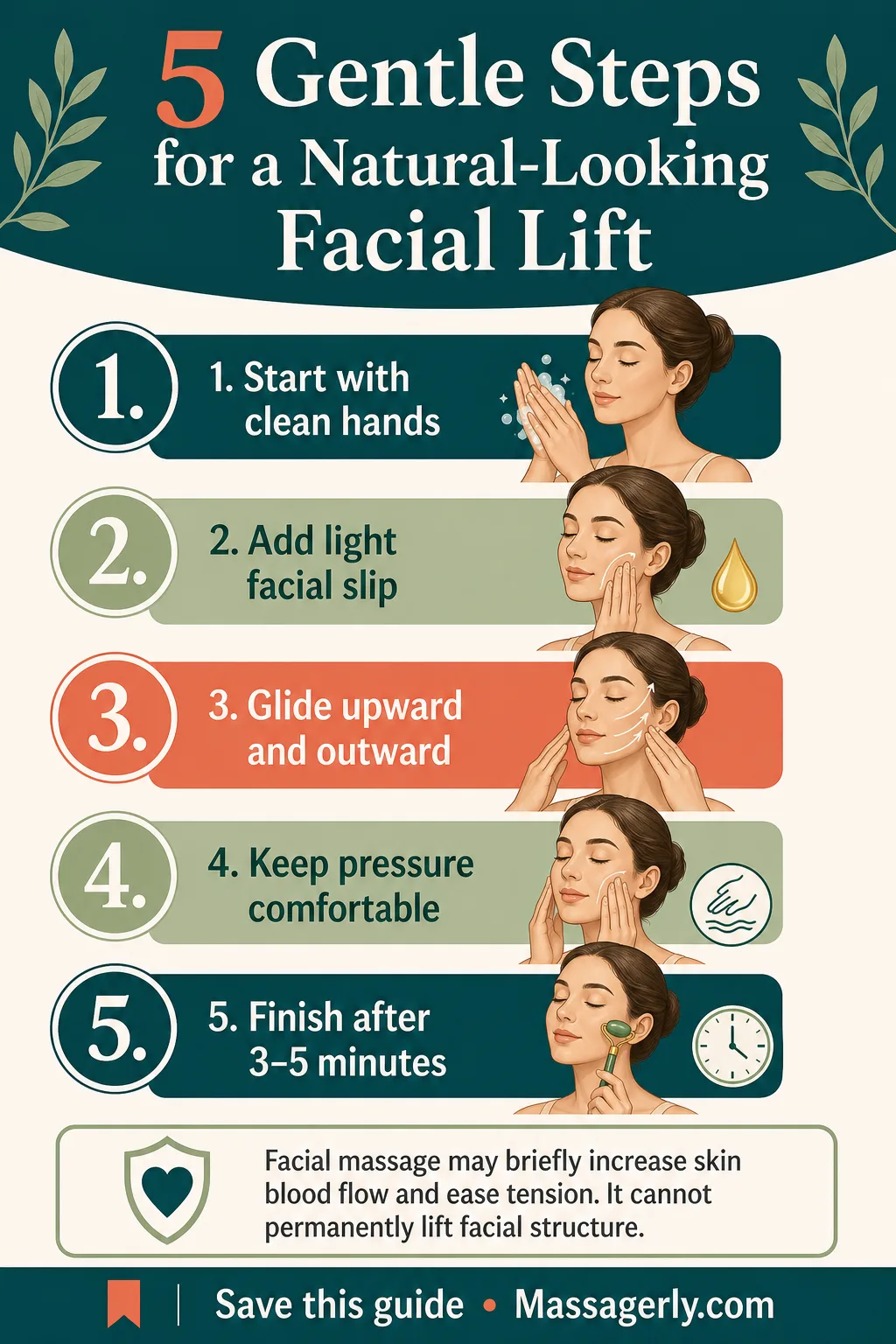
A natural-lift routine should be understood as skin care and comfortable touch—not structural surgery without surgery. Lighting, hydration, temporary fluid movement and facial expression can all change how the face looks immediately afterward.
What may change temporarily
Gentle strokes can spread moisturizer, reduce surface friction and create a short-lived sense of relaxation. Puffiness may fluctuate during the day, but a before-and-after photo does not prove lasting tissue lifting.
A five-minute gentle routine
- Wash hands and remove irritating products.
- Apply a small amount of compatible moisturizer.
- Glide from the center of the forehead outward without pulling.
- Use feather-light strokes around the orbital bone, never the eyeball.
- Move along the cheeks and jaw with comfortable pressure.
- Stop for pain, visual change, dizziness or lasting redness.
Who should pause
Do not massage active infection, a painful rash, open skin, unexplained swelling or a new injury. Follow the injector’s or surgeon’s instructions after filler, threads, laser treatment or surgery. People with eye disease should avoid pressure on the globe unless specifically instructed by an eye-care professional.
Claims to reject
| Claim | Reason for caution |
|---|---|
| Permanent facelift | Massage does not reposition surgically supported tissue |
| Guaranteed collagen production | No home routine guarantees structural remodeling |
| Fat melting | Topical pressure does not selectively remove facial fat |
| Wrinkle removal | Temporary surface changes are not permanent correction |
When to seek advice
New facial weakness, sudden asymmetry, vision loss, severe eye pain or signs of stroke require urgent care. Persistent swelling, pain, skin discoloration or symptoms after a cosmetic procedure should be assessed by the treating clinician.
What current evidence says
Research on facial rollers and massage is generally small and short term. It may measure temporary skin blood flow, thickness or subjective appearance, but it does not establish equivalence to a facelift or reliable long-term lifting.
Related Massagerly guides
Compare massage after surgical facelift, under-eye filler precautions, eye-area massage safety, facial oil and pore safety and patch testing.
Set a realistic goal before starting
Choose a goal that massage can plausibly serve: spreading moisturizer, taking a screen break, relaxing jaw or brow tension, or enjoying a gentle skincare ritual. “Permanent lift,” “fat melting” and “facelift without surgery” are marketing outcomes, not responsible promises.
Pressure map for a gentle routine
| Area | Pressure | Avoid |
|---|---|---|
| Forehead and temples | Light, comfortable gliding | Dragging dry skin |
| Cheeks and jaw | Light to moderate only if comfortable | Painful pinching or scraping |
| Eye area | Feather-light around the orbital bone | Pressure on the eyeball |
| Recently treated skin | Only after professional clearance | Heat, tools and aggressive manipulation |
How to judge the result honestly
Use the same lighting, head position, expression and camera distance if you compare photographs. Immediate changes in redness, hydration, facial expression or morning puffiness can create a dramatic photo without showing tissue lifting. Check whether any change remains after several hours rather than relying on a single before-and-after image.
Tools are optional
Hands are easier to control and clean than many rollers, stones or suction tools. If you use a tool, keep it clean, avoid sharp edges and stop if it causes petechiae, bruising, numbness or lasting redness. More pressure is not evidence of more benefit.
Questions readers often ask
Can facial massage build collagen?
Small studies may measure short-term skin variables, but they do not support a guaranteed collagen-building or facelift effect from a home routine.
Can it remove a double chin?
Massage does not selectively remove fat. Seek individualized advice if a lump, swelling or sudden asymmetry is new.
Can I massage after filler, threads, laser treatment or surgery?
Only when the treating professional approves the timing, area and pressure. Some procedures specifically require avoiding pressure during early recovery.
Build a skin-safe routine, not a pressure challenge
Use clean hands, short nails and enough compatible product to prevent dragging. A routine should leave the skin comfortable within a short time. Burning, broken capillaries, pinpoint spots, bruising or numbness are signs to stop—not evidence that circulation or lymph flow has been “activated.” A 2023 open prospective study reported visible and self-rated changes after a prescribed two-week routine, but its design and industry affiliations mean it should not be presented as proof of a surgical-equivalent lift.
People using retinoids, exfoliating acids or prescription skin treatments may be more irritation-prone. Avoid stacking aggressive massage with scrubs, peels, suction or heat. If facial asymmetry, swelling, pain or weakness is new rather than cosmetic and longstanding, seek assessment instead of attempting to reshape it with pressure.
Saveable visual summary