Sensitive skin can turn a relaxing massage into an itchy guessing game. The safest starting point is not the fanciest “natural” blend. It is usually a simple, fragrance-free massage oil with a short ingredient list—and no ingredient you already know you react to.
If you want one practical first option, consider a plain, fragrance-free carrier oil such as jojoba, fractionated coconut, grapeseed, or sunflower oil. None is allergy-proof, and research does not prove that one oil is best for every person. Your allergy history, skin condition, desired glide, and the complete product formula matter more than a fashionable ingredient.
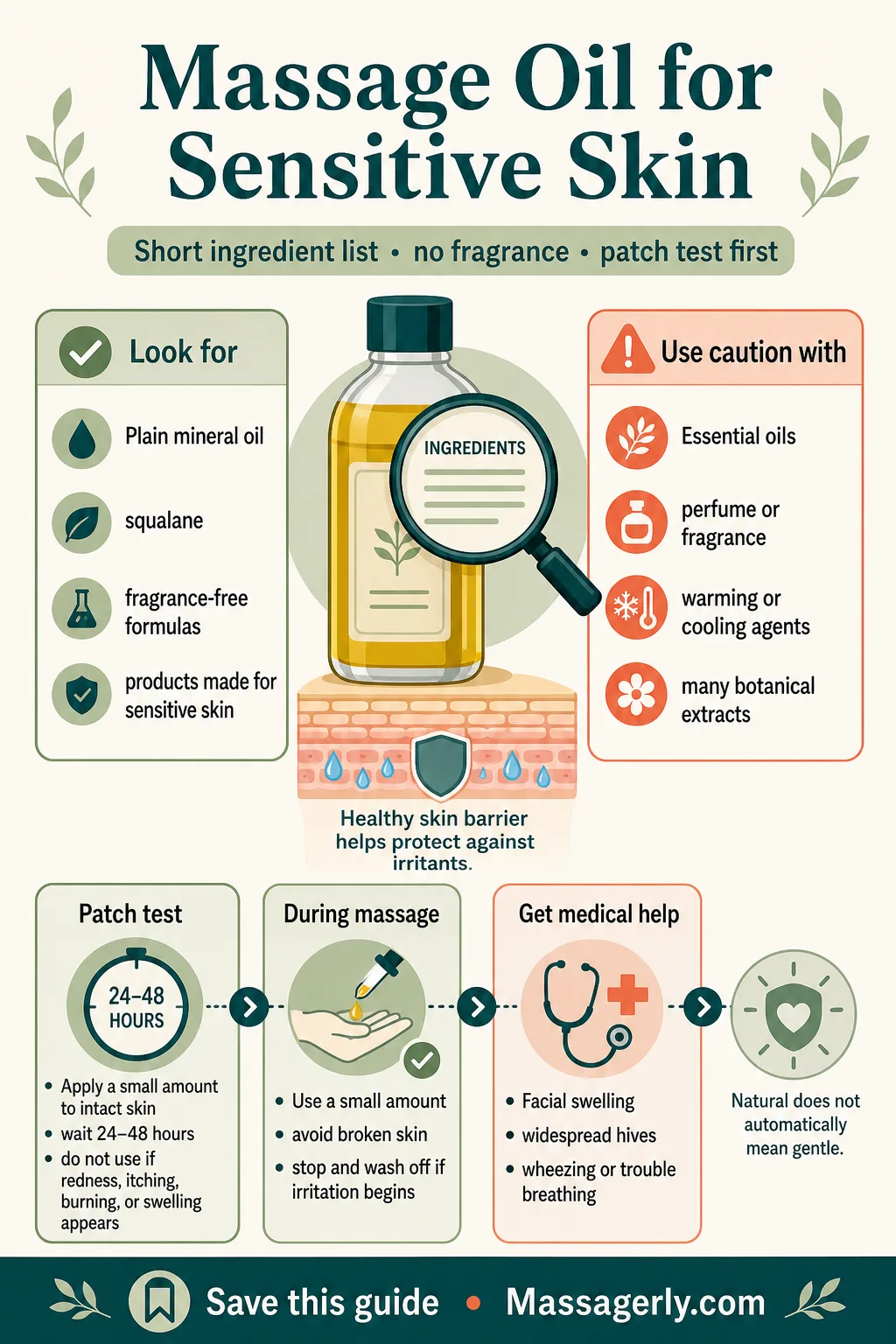
Quick answer: Choose an unscented or fragrance-free oil with as few ingredients as possible. Avoid essential oils and added perfume on reactive skin, check for personal allergens, test a small area first, and stop if you notice burning, itching, swelling, or a spreading rash.
Best Massage Oils for Sensitive Skin at a Glance
| Oil or formula | How it feels | Why people choose it | Main caution |
|---|---|---|---|
| Jojoba | Silky, medium-light | Stable and nearly odorless; useful glide | Still possible to react; direct massage evidence is limited |
| Fractionated coconut | Light, smooth | Liquid at room temperature and easy to spread | Avoid with a known coconut sensitivity; may not suit acne-prone areas |
| Grapeseed | Light, less greasy | Good when a heavy residue is unwanted | Shorter-feeling glide may require careful reapplication |
| Sunflower seed | Light to medium | Affordable; some skin-barrier research exists | Much of the massage research involves newborns, not adults |
| Fragrance-free professional blend | Varies | Can balance glide, absorption, and shelf life | Read every ingredient; “hypoallergenic” is not a guarantee |
| Sweet almond | Rich, long glide | Popular with massage therapists | Skip it when a tree-nut allergy or uncertainty is involved |
This table compares practical characteristics, not a medical ranking. A product can be pleasant for many people and still be wrong for one person. When skin is very reactive, a single-ingredient option makes it easier to identify what touched the skin.
What “Sensitive Skin” Actually Means
“Sensitive skin” is a useful description, but it is not one single diagnosis. One person may sting after fragranced products. Another may have eczema, rosacea, a known contact allergy, very dry skin, or irritation caused by rubbing. Those problems do not all have the same trigger.
Irritation and allergy are also different. An irritant reaction can happen when a product, heat, or friction directly overwhelms the skin. An allergic contact reaction happens after the immune system has become sensitive to a particular substance. Both can look red and itchy, so repeated or serious reactions deserve professional assessment rather than more home experiments.
How to Choose a Massage Oil for Sensitive Skin
1. Start with a short ingredient list
A simple formula reduces the number of possible triggers. Look for a clear ingredient list rather than relying only on words such as “clean,” “gentle,” “natural,” or “spa quality.” These marketing terms do not tell you whether the product contains something that your skin dislikes.
For a first test, a plain carrier oil or a genuinely fragrance-free professional massage formula is easier to evaluate than a blend containing ten plant extracts, perfume, color, and several essential oils.
2. Prefer fragrance-free—not just unscented
“Unscented” means you may not notice a smell. It does not always mean that no fragrance-related ingredients were used. A masking fragrance can be added to reduce another odor. “Fragrance-free” is usually the more useful label, but you should still read the full ingredient list.
Watch for fragrance, parfum, essential oils, and fragrant components such as limonene, linalool, eugenol, or citral if fragrance has caused trouble for you before. A dermatologist’s patch-test report should take priority over any general online list.
3. Check personal allergy conflicts
Sweet almond oil gives excellent glide, but it is not a sensible default when the recipient has a tree-nut allergy or does not know the severity of a previous reaction. The same rule applies to coconut, seed oils, botanicals, preservatives, and any ingredient that has caused a problem before: do not “test your luck” during a full-body massage.
4. Match the texture to the massage
Too little slip increases rubbing; too much makes control difficult. Jojoba and professional blends often give a balanced feel. Grapeseed and fractionated coconut tend to feel lighter. Sweet almond feels richer and usually lasts longer, but it brings the allergy concern mentioned above.
Start with a small amount in your hands and add more only when needed. Pouring a large puddle directly onto the body makes both temperature and friction harder to control.
5. Use a fresh, well-stored product
Air, light, heat, water, and repeated hand contact can shorten an oil’s useful life. Keep the cap closed, store it as the manufacturer directs, and discard it if the smell, color, or texture changes unexpectedly. For a warmer first touch, follow our guide to warming massage oil safely instead of placing the main bottle over direct heat.
Carrier Oils vs. Essential Oils
Carrier oils make up most of a massage product and provide the glide. Essential oils are concentrated aromatic materials added in small amounts. They are not interchangeable, and undiluted essential oil should not be used as massage oil.
For sensitive skin, fragrance-free carrier oil is the simpler starting point. Lavender, tea tree, peppermint, eucalyptus, citrus, cinnamon, and other essential oils can smell pleasant, but “natural” does not make them non-allergenic. Dilution can reduce exposure; it cannot promise that an allergic person will not react.
What Research Says
Research specifically comparing adult massage oils for sensitive skin is surprisingly thin. The best recent evidence answers smaller questions about fragrance allergy, essential-oil reactions, dry-skin care, and particular massage traditions. Here is what those studies actually tell us.
1. Scented leave-on products deserve extra caution
A 2021 European population study, Skin Exposure to Scented Products Used in Daily Life and Fragrance Contact Allergy, patch-tested 3,119 people and interviewed them about scented-product exposure. Sensitive skin was associated with fragrance allergy, and exposure to leave-on scented products was among the relationships the researchers examined.
In simple English: fragrance sensitivity is not an imaginary concern, and a massage oil stays on a large area of skin. The study was observational, so it cannot prove that one use of a scented oil causes allergy. It does support choosing fragrance-free products when someone already reports reactive skin.
2. Essential oils can cause real contact allergy
A 2023 French study, Allergic Contact Dermatitis from Essential Oil in Consumer Products, described 42 patients who were sensitized to essential oils they had used. Lavender, tea tree, and ravintsara were prominent in the series, and eight patients required hospital care.
In simple English: an essential oil can trigger more than a momentary tingle in a sensitized person. This study looked at people who already had dermatitis and does not tell us how often reactions happen among all users. It does show why a fragranced “natural” blend should not automatically be called safe for sensitive skin.
3. Oil-based care can help dry skin—but that is not the same as proving a massage oil
In a 2017 randomized study, The Effectiveness of Using a Bath Oil to Reduce Signs of Dry Skin, 60 children and adults with mild-to-moderate dry skin used either a bath oil or their usual non-oil cleanser for 28 days. The bath-oil group had lower water loss through the skin and higher skin hydration at the end.
In simple English: an oil-containing skin-care routine can support dry skin. But the researchers tested a particular bath product and routine—not every carrier oil and not a one-hour massage. We should not turn this result into a claim that any massage oil “repairs” sensitive skin.
4. Results from one oil and one age group do not apply to everyone
A 2019 cluster-randomized trial, Impact of Sunflower Seed Oil Versus Mustard Seed Oil on Skin Barrier Function in Newborns, involved 995 newborns receiving routine massage. The study found some differences between the oil groups, but it did not show a simple, universal improvement across every skin-barrier measure.
In simple English: the type of oil may matter, yet even a large massage study does not produce a one-size-fits-all winner. These were newborns in Nepal, not adults choosing a spa oil. We can learn to avoid sweeping claims, not use the study as proof that sunflower oil is best for every sensitive adult.
How to Patch Test a New Massage Oil
- Do not test on broken, freshly shaved, sunburned, inflamed, or actively eczematous skin.
- Place a small amount on a limited area of the inner forearm.
- Leave it alone and monitor the area for 24–48 hours.
- Wash it off and stop sooner if burning, strong itching, swelling, blistering, or a spreading rash appears.
- If the small test stays comfortable, use a modest amount for the first massage and check the skin again later.
A home patch test can catch an obvious reaction, but it cannot guarantee future safety or diagnose an allergy. Delayed allergy testing uses controlled materials and interpretation by a clinician. If reactions recur, ask a dermatologist about formal patch testing and take the product or ingredient list with you.
When You Should Skip the Massage
Do not massage an area with hives, open wounds, weeping eczema, a spreading rash, infection, severe sunburn, or unexplained swelling. Stop immediately if the recipient reports burning, breathing difficulty, dizziness, facial swelling, or rapidly worsening symptoms. Breathing difficulty or swelling of the lips, tongue, or throat needs urgent medical help.
If a clinician has diagnosed eczema, psoriasis, rosacea, contact allergy, or another skin condition, follow that person’s treatment advice. Massage oil is a lubricant and comfort product; it is not a substitute for medical care.
Frequently Asked Questions
Is jojoba oil good for sensitive-skin massage?
Jojoba is a practical option because it is stable, has little odor, and provides smooth glide. However, clinical evidence specifically proving it is the best adult sensitive-skin massage oil is limited. Choose a plain product, check personal allergies, and test a small area first.
Is coconut oil safe for sensitive skin?
Many people tolerate it, but not everyone does. Fractionated coconut oil stays liquid and feels lighter than regular coconut oil. Avoid it if coconut products have caused a reaction, and be cautious on acne-prone areas. Our coconut oil body-massage guide explains its texture and use in more detail.
Does “hypoallergenic” mean no one will react?
No. It generally means the product is formulated to reduce the chance of a reaction. It cannot promise zero risk, and the label does not replace a complete ingredient list.
Can I add lavender oil for relaxation?
If the recipient has sensitive or fragrance-allergic skin, the simpler choice is to leave it out. Lavender is one of the essential oils reported in contact-allergy research. Use a fragrance-free environment for relaxation instead.
Should sensitive-skin massage oil be warmed?
It can be gently warmed for comfort, but heat adds another possible source of irritation. Keep it mildly warm, mix it, and test the temperature before use. A hot-oil massage should feel comfortably warm, never intense.
The Bottom Line
The best massage oil for sensitive skin is the one with the fewest relevant risks for the individual using it. Start with a simple fragrance-free carrier oil or professional blend, avoid known allergens and unnecessary essential oils, test a small area, and use only enough for comfortable glide.
Recent research supports caution around scented leave-on products and confirms that essential oils can cause allergic contact dermatitis. It also reminds us that results from bath oils, newborn massage, or a particular formula cannot crown one universal winner. For sensitive skin, honest limits and a short ingredient list are more useful than miracle claims.