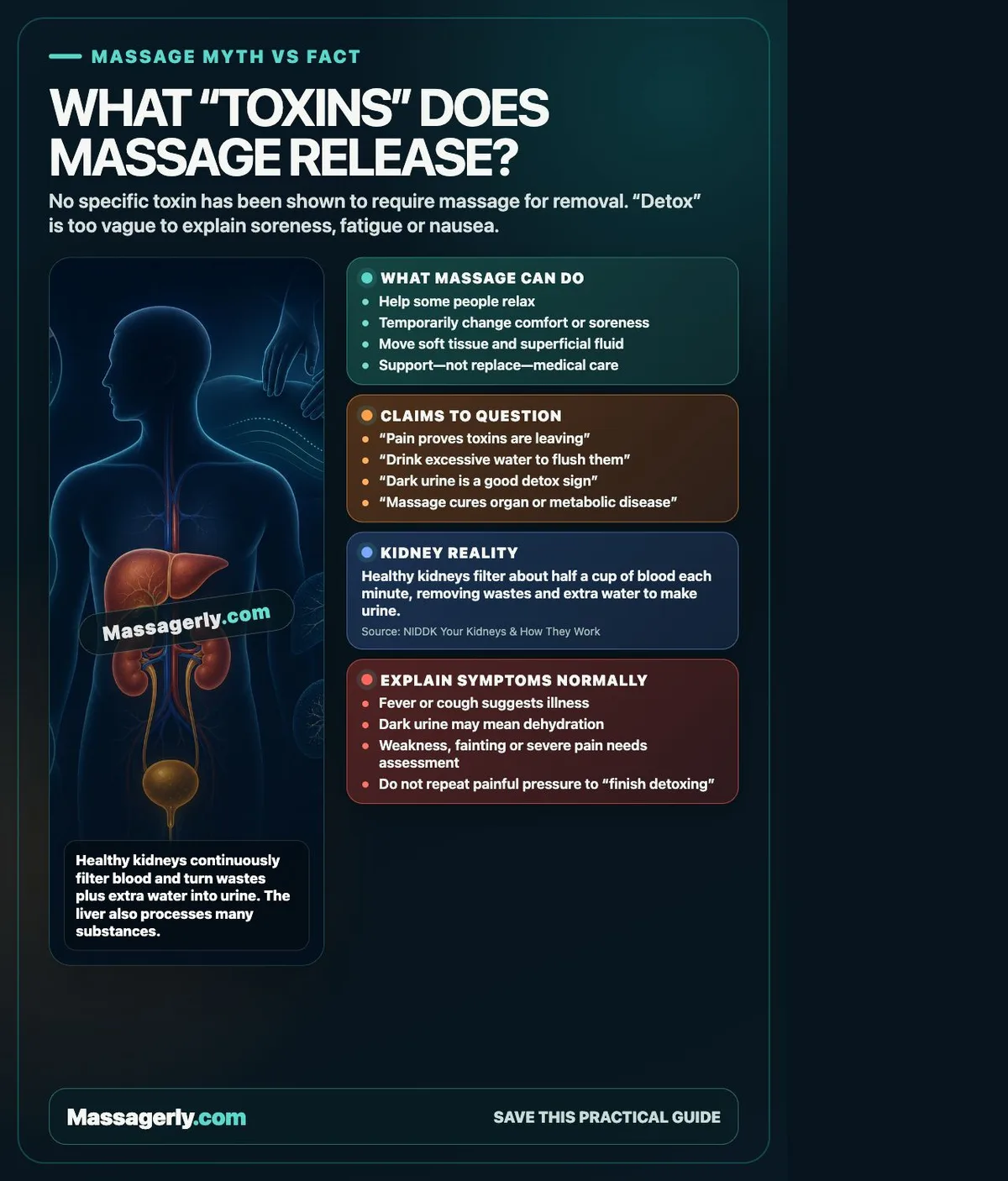
The phrase “massage detox” sounds scientific because it borrows words from metabolism and circulation. The problem is that it combines unrelated substances and then claims that pressure pushes them out. Human physiology does not work that way. The liver, kidneys, lungs, gut and skin already process or remove different substances through specific pathways.
What people mean when they say ‘toxins’
In medicine, a toxin is a harmful substance with a defined source, dose and effect. Wellness articles often use the word for lactate, ordinary metabolic products, stress hormones, pollutants and even normal inflammatory signals. Those substances cannot be treated as one material stored inside a muscle. A credible claim must name the substance, show that massage changes it, and explain whether that change matters clinically.
Lactate is not stored post-exercise poison
Working muscle can produce lactate, but lactate is also a useful fuel and signaling molecule. It is cleared and reused through normal metabolism. Delayed soreness a day or two after activity is not caused by trapped lactate. A large 2023 systematic review of sport massage found no consistent change in blood-lactate clearance.
Massage does not squeeze waste into the kidneys
The kidneys filter blood according to blood flow, pressure and the properties of individual molecules. There is no established pathway in which massage dislodges a mixed package of waste from healthy muscle and sends it to the kidneys. Drinking normally is sensible, but forced water does not prove or accelerate a massage detox.
Why someone may feel different afterward
Strong pressure can produce local tenderness. Heat, scent, prolonged positioning, a missed meal, migraine triggers, usual caffeine changes, anxiety, medication effects or an unrelated infection can contribute to headache, nausea or fatigue. Rarely, very forceful massage can be associated with injury. These explanations should be assessed on their own instead of being grouped as a healing crisis.
A practical symptom check
| After-massage finding | More useful question | Response |
|---|---|---|
| Local tenderness | Was the pressure unusually strong? | Reduce pressure and monitor |
| Fever, cough or sore throat | Could an infection already be developing? | Postpone massage and follow illness guidance |
| Dizziness or nausea | Did position, heat, food, caffeine or medicine contribute? | Sit safely and reassess |
| Dark urine, marked swelling or weakness | Could this be more than ordinary soreness? | Seek urgent medical assessment |
When to seek care
Seek urgent help for chest pain, breathing difficulty, fainting, confusion, new weakness, severe or rapidly worsening pain, major swelling or dark urine. A persistent measured fever, repeated vomiting or symptoms that do not improve as expected also deserve medical advice.
What current evidence says
The U.S. National Center for Complementary and Integrative Health notes that massage may help some conditions but that evidence varies and rare serious adverse effects have been reported. A 2023 systematic review of massage in sport and exercise found no change in blood-lactate clearance, muscle blood flow or muscle temperature. These sources support realistic, outcome-specific claims—not a generalized detox mechanism.
Related Massagerly guides
Compare flu-like symptoms after massage, nausea and fatigue after massage, ordinary soreness and warning signs, deep-tissue aftercare and post-massage headaches.
What actually happens during and after massage?
Massage changes pressure on skin and soft tissue, creates sensory input and may temporarily change how tense or relaxed a person feels. That does not mean a hidden store of poisons has been squeezed into the blood. Normal metabolism continuously produces substances that the lungs, liver, kidneys, gut and skin handle through ordinary physiology. A massage session is not required to switch those systems on.
Lactate is especially misunderstood. Muscles can produce lactate during intense activity, but it is a usable metabolic intermediate rather than a toxic sludge. Delayed soreness that appears the next day is not caused by lactate remaining trapped in muscle. A 2023 systematic review of sports massage found no meaningful effect on blood-lactate clearance and cautioned against stretching sports findings into broad physiological promises.
Why might someone still feel different?
A person may feel sleepy after relaxing quietly, sore after unfamiliar pressure, light-headed when standing quickly, nauseated after heat or a large meal, or irritated by fragrance. Someone can also develop a migraine or infection at the same time by coincidence. These possibilities call for ordinary symptom assessment, not a detox label.
A better after-massage checklist
- Stand up slowly and notice whether dizziness settles.
- Drink according to thirst; do not force extreme amounts of water.
- Eat normally if a missed meal may be contributing.
- Avoid repeating strong pressure over a painful or bruised area.
- Record fever, vomiting, weakness, urine changes or symptoms that are worsening.
Questions readers often ask
Does sweat prove toxins are leaving?
No. Sweating mainly helps regulate temperature and contains water and electrolytes. Sweating during a heated session does not validate a detox claim.
Should urine change after massage?
A normal session should not be promoted as a way to change urine. Dark urine, very low urine output, severe muscle pain or weakness deserves medical assessment rather than more massage.
Is massage useless if it does not detox?
No. Relaxation, comfort, short-term symptom relief and an enjoyable wellness routine can still be worthwhile goals. They should be described honestly rather than supported with a false mechanism.
Editorial correction: Earlier wording on this page described lactate, cortisol, histamine and metabolic waste as interchangeable toxins released by massage. That explanation was removed because it is not supported by current evidence.
Saveable visual summary